Wedelia: The Wall of Green
Coverage first, flowers later — gardening on purpose
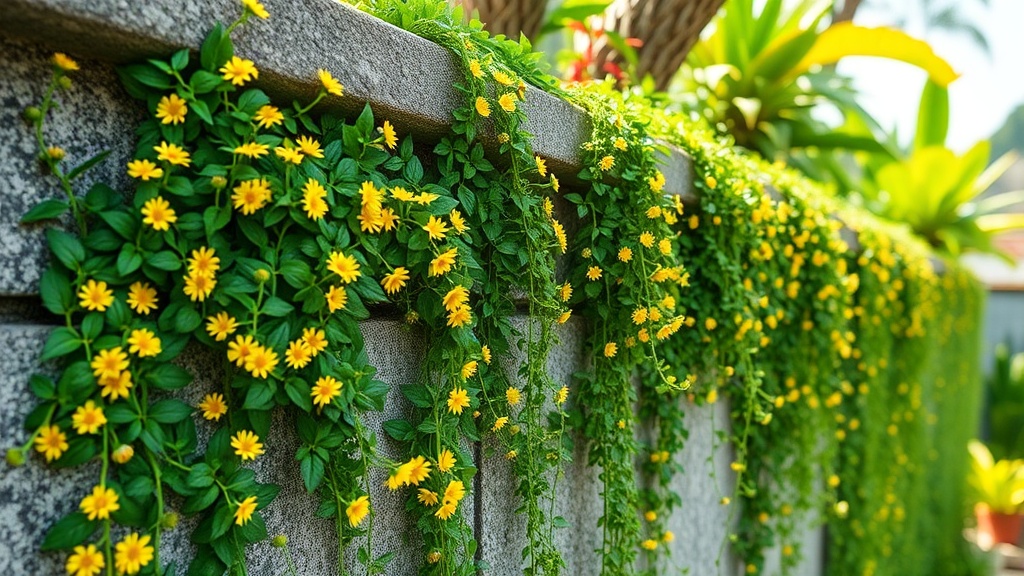
The Goal
Four wedelia plants, positioned at the top of walls where they can cascade downward. The mission wasn’t flowers — it was coverage. Green walls. Living curtains spilling over the edges of the terrace, softening the hard lines of concrete, creating the look of abundance.
This is one of the few plants in the garden where I deliberately chose not to optimize for flowers. At least not yet.
The Strategy
When Claude helped me build the feeding plan for all 26 plant types, wedelia was categorized into Group D: Coverage Plants — alongside the curtain creeper. The feeding regime was intentionally different from everything else:
- Urea — pure nitrogen, dissolved in water
- Ferrous sulfate (1/2 tbsp) — pH correction
- Frequency: every 3–4 weeks
No DAP. No potash. Just nitrogen.
The reasoning: nitrogen drives leaf and stem growth. It tells the plant to expand, spread, put out runners. Phosphorus (DAP) and potassium (potash) would signal the plant to shift energy toward flowering and reproduction — exactly the opposite of what I wanted at this stage.
This is gardening with intent. Not just feeding a plant and hoping for the best, but choosing a specific nutritional signal to drive a specific behavior.
The Result
The wedelia responded exactly as designed. By January 31st:
“Wedelia are going strong, they are dropping their hanging creepers, hope they start flowering soon.”
The “dropping their hanging creepers” is the visual I was after — stems growing long enough to spill over the wall edges and cascade downward. Green curtains forming, coverage expanding.
But no flowers yet. And I noticed I was starting to want them.
The Switch
Claude mapped out the transition plan:
| Coverage status | Action |
|---|---|
| Still expanding, gaps to fill | Continue urea |
| 70–80% coverage achieved | Switch to NPK |
| Want to trigger flowering | Add DAP (phosphorus) |
The biology is straightforward: wedelia flowers when it feels established. While it’s still in expansion mode — putting energy into runners, rooting at nodes, colonizing new territory — flowers are a low priority. The plant is focused on real estate, not reproduction.
To trigger the switch:
| Feed | Dose | Frequency |
|---|---|---|
| NPK | 1 tbsp dissolved | Every 3–4 weeks |
| DAP | 1/2 tbsp | Every 4–6 weeks |
| Ferrous sulfate | 1/2 tbsp | If pH above 7 |
Within 3–4 weeks of the switch, small yellow daisy-like flowers should begin appearing across the green curtain.
The timing is my choice. Once the coverage is where I want it, I change the diet, and the plant changes its behavior. It’s like flipping a switch — from vegetative mode to reproductive mode — using nothing but nutrition.
The Curtain Creeper Companion
The curtain creeper — one plant, same Group D treatment — is on the same trajectory. Urea for coverage, eventual switch to NPK+DAP for flowering. Together, the wedelia and curtain creeper are building the garden’s green infrastructure: the living walls and cascading foliage that give the rooftop its lush, established look.
They’re not the stars. Nobody photographs the curtain creeper. But they’re the background that makes the bougainvillea and hibiscus look like they belong in a garden rather than sitting on a concrete roof.
What I Learned
About intentional feeding: Most gardening advice is “feed your plants.” The AI approach was more specific: what do you want this plant to do? Coverage? Feed nitrogen. Flowers? Feed phosphorus and potassium. Fruit? Potassium-heavy. The plant responds to the signal you give it. Knowing which signal to send — and when to change it — is the difference between gardening and just watering.
About patience as strategy: The wedelia “strategy” is really just patience with a plan. Don’t feed for flowers yet. Let coverage build. When it’s ready, change the diet. The flowers will come when they’re invited. This is different from the impatient approach of feeding everything the same way and hoping for the best.
About background plants: A garden isn’t just its stars. The wedelia and curtain creeper don’t produce the dramatic blooms of bougainvillea or the fragrance of night jasmine. But they create the canvas on which those stars perform. Without green walls and cascading foliage, the flowering plants would just be pots on concrete. The background plants are what make it a garden.
Current Status
| Aspect | Status |
|---|---|
| Plants | 4 wedelia + 1 curtain creeper |
| Coverage | Expanding — dropping hanging creepers over walls |
| Flowers | Pending — will trigger with diet switch |
| Treatment | Urea + Ferrous sulfate every 3–4 weeks |
| Next step | Switch to NPK + DAP when coverage reaches 70–80% |
| pH | Correcting with ferrous sulfate |
| Biggest lesson | You can choose what a plant does by choosing what you feed it |
Part of the AI in the Garden series — documenting what happens when artificial intelligence meets living things.