Hibiscus: The Virus Detective Story
When nine plants bloom and one won’t — what does that tell you?
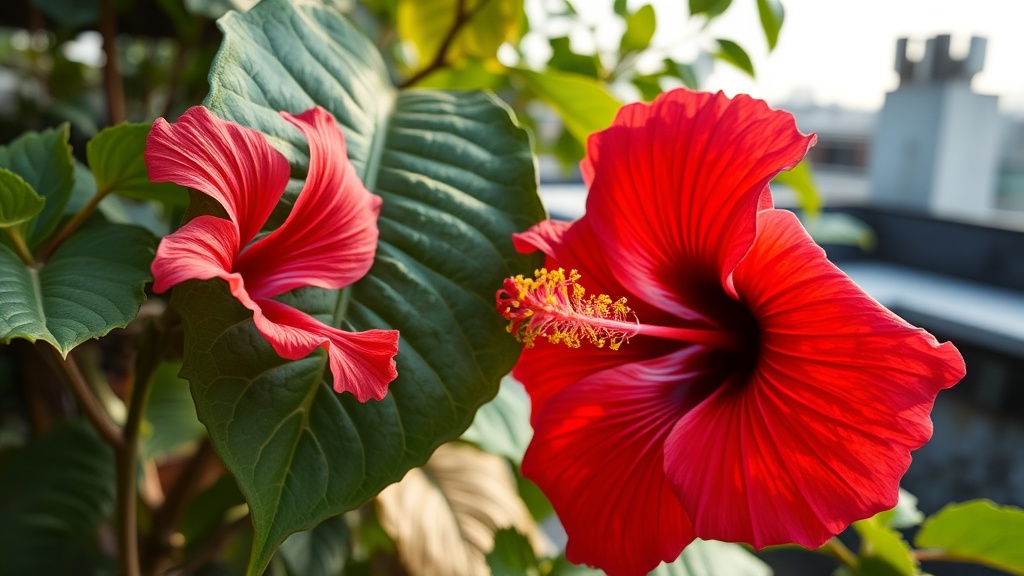
Ten Hibiscus, One Mystery
I have ten hibiscus plants in the rooftop garden. After the pH correction and ferrous sulfate treatment, nine of them decided to bloom together — a coordinated explosion of buds, leaves, and color. The garden update on January 17th was enthusiastic:
“The hibiscus garden seem to all have decided to bloom together, plentiful buds on all the hibiscus’s.”
But one plant — the yellow hibiscus — told a different story. Its leaves were wrinkled. Its buds were misshapen. The flowers that did form were deformed and dropped before fully opening. I had assumed it was pest damage, but even as the bug population declined across the garden (healthier plants resist pests better), this one plant didn’t improve.
This was the plant that would teach me the most about AI-assisted diagnosis.
The Differential Diagnosis
When I described the yellow hibiscus to Claude — wrinkly leaves, misshapen buds that drop, no improvement despite fertilizer and reduced pest pressure — the response was structured like a medical differential:
Ruled out:
- Nutrient deficiency — the other nine hibiscus recovered, same treatment
- pH lockout — same soil correction applied to all
- Common pests — bug population down, symptoms persist
- Light or water — same conditions as healthy plants
Remaining suspects:
- Viral infection — likely Hibiscus Leaf Curl Virus
- Microscopic mites — broad mites or cyclamen mites, invisible to the naked eye
Both produce nearly identical symptoms: distorted new growth, misshapen buds, leaves that wrinkle and fail to develop properly. The key difference? Mites can be treated. Viruses cannot.
The Test
Claude proposed a structured diagnostic test:
| Week | Action |
|---|---|
| 1 | Spray abamectin (miticide) — covers all leaf surfaces, especially undersides |
| 2 | Repeat spray |
| 3 | Repeat spray |
| 4 | Observe new growth |
If new growth improves → It was mites. Continue preventive sprays.
If no improvement → Likely virus. Make a hard decision.
This is what struck me about the AI approach: it didn’t guess. It proposed a falsifiable test — apply a known treatment for one cause, observe whether the effect changes. If the treatment works, one diagnosis is confirmed. If not, the other becomes likely by elimination.
The Hard Truth About Plant Viruses
Claude was direct about what a virus diagnosis would mean:
- No cure exists — no spray, fertilizer, or treatment can fix a viral infection
- Spreads via sap — pruning tools, hands, and sucking insects can transmit it
- Persists in the plant — it will never fully recover
- Can infect others — the nine healthy hibiscus are at risk
The immediate advice: isolate the plant. Move it away from the others. Sterilize pruning tools before and after touching it. Don’t propagate from it.
Meanwhile, the Other Nine
The contrast tells the story of the pH correction more than anything. Before treatment, some hibiscus weren’t flowering. After ferrous sulfate brought the soil pH from 8 down toward 6.5, they responded dramatically. By January 31st, the entire hibiscus section — minus the yellow one — was in full bloom.
The AI observation that resonated most: “Healthy plants resist pests — proof that nutrition is better than pesticides.” The ixora had the same experience — bugs disappeared not because of any pesticide, but because a well-fed plant is harder for pests to attack. The bugs didn’t die. They just went elsewhere, looking for weaker hosts.
The Yellow Hibiscus
Even with its suspected virus, the yellow hibiscus doesn’t give up. The January 31st update:
“The sickly yellow one is also popping out flowers and buds, all mis-shaped, but nevertheless growing and pumping out stuff.”
There’s something admirable about that. A plant with compromised genetics, fighting a battle it can’t win, still pushing out blooms however misshapen. It’s the most beautiful variety in the garden — strikingly yellow, large flower — and possibly the most vulnerable.
The abamectin test is still pending. If it’s mites, the plant gets a reprieve. If it’s virus, I’ll keep it isolated and let it live out its days producing whatever distorted beauty it can. Sometimes that’s the best you can offer.
What I Learned
About diagnosis: The most valuable thing AI did here wasn’t providing an answer — it was structuring the question. By systematically ruling out causes (nutrients, pH, common pests, environment) and proposing a falsifiable test, it turned a frustrating mystery into a solvable problem. Even if the answer turns out to be bad news, knowing is better than guessing.
About gardens as controlled experiments: Having ten plants of the same species under the same conditions, with only one behaving differently, is a natural experiment. The AI recognized this immediately — the nine healthy plants serve as the control group. Any diagnosis that applies to one plant but not its identical neighbors must be plant-specific (virus, localized pests) rather than environmental.
About the limits of care: Some problems can’t be solved by trying harder. No amount of fertilizer, pH correction, or attention will cure a viral infection. Learning to recognize unsolvable problems — and making peace with them — is part of gardening. And part of life.
Current Status
| Aspect | Status |
|---|---|
| Healthy hibiscus | 9 — blooming vigorously |
| Yellow hibiscus | 1 — isolated, suspected virus or mites |
| Treatment (healthy) | NPK + Epsom salt + Ferrous sulfate every 3–4 weeks |
| Treatment (yellow) | Abamectin test pending |
| pH | Correcting toward 6.0–6.5 (acid-loving) |
| Key insight | When 9 recover and 1 doesn’t, the problem is in the one |
Part of the AI in the Garden series — documenting what happens when artificial intelligence meets living things.